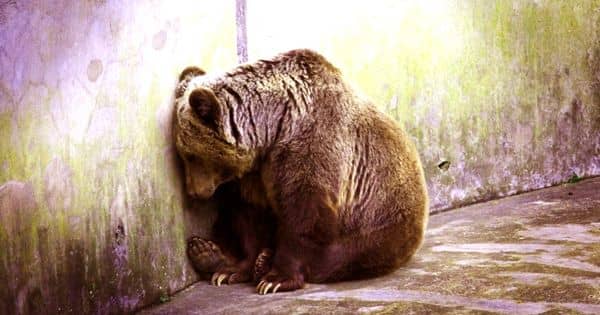
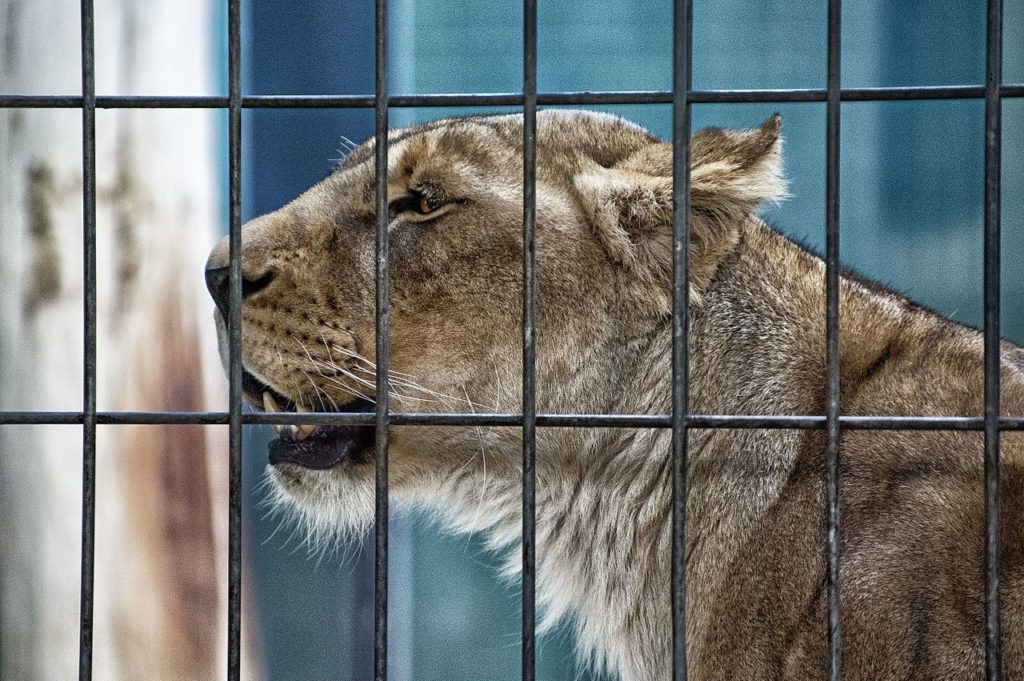
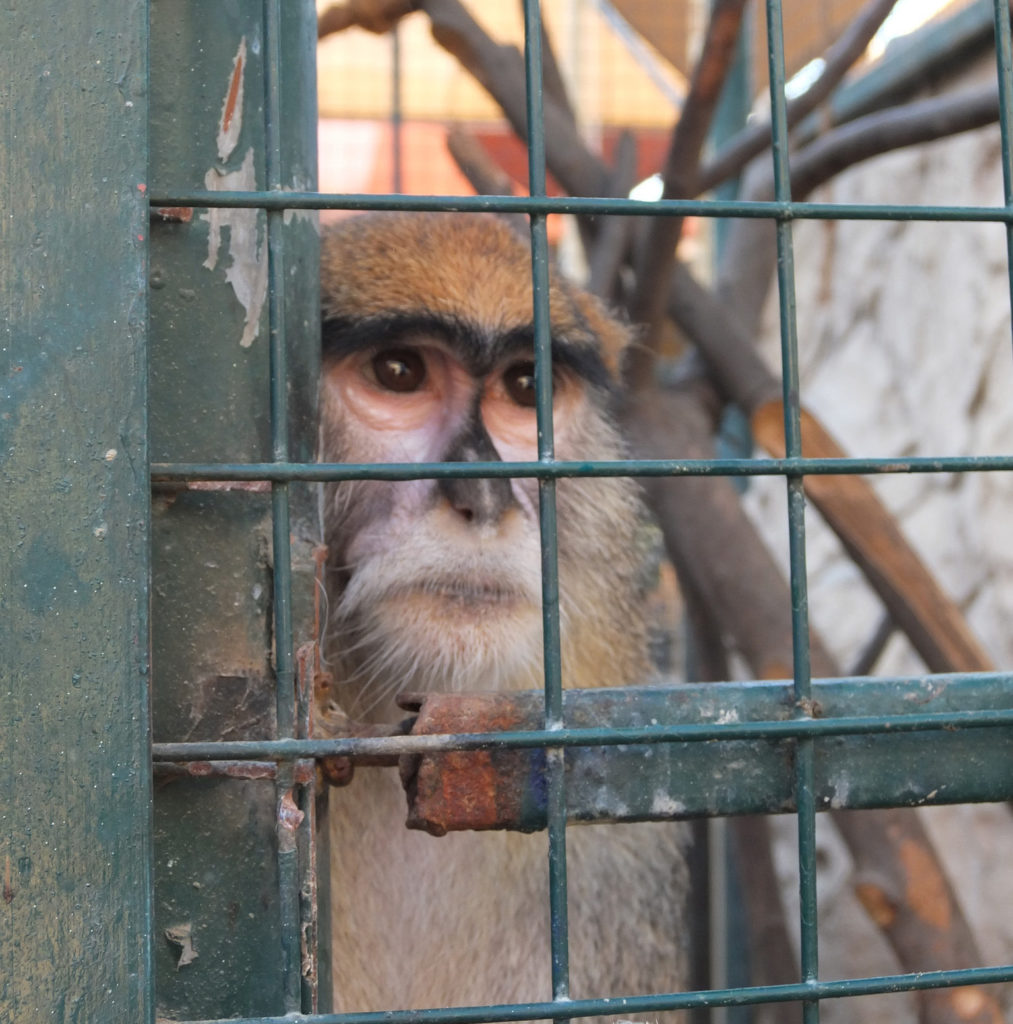
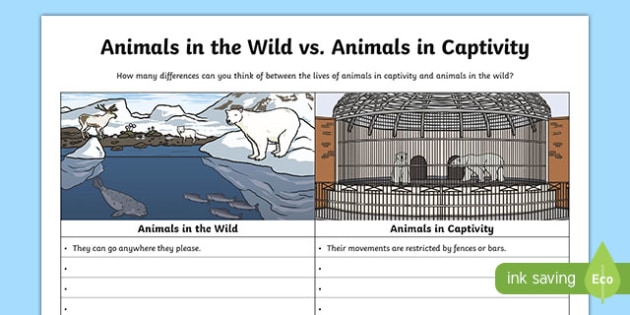
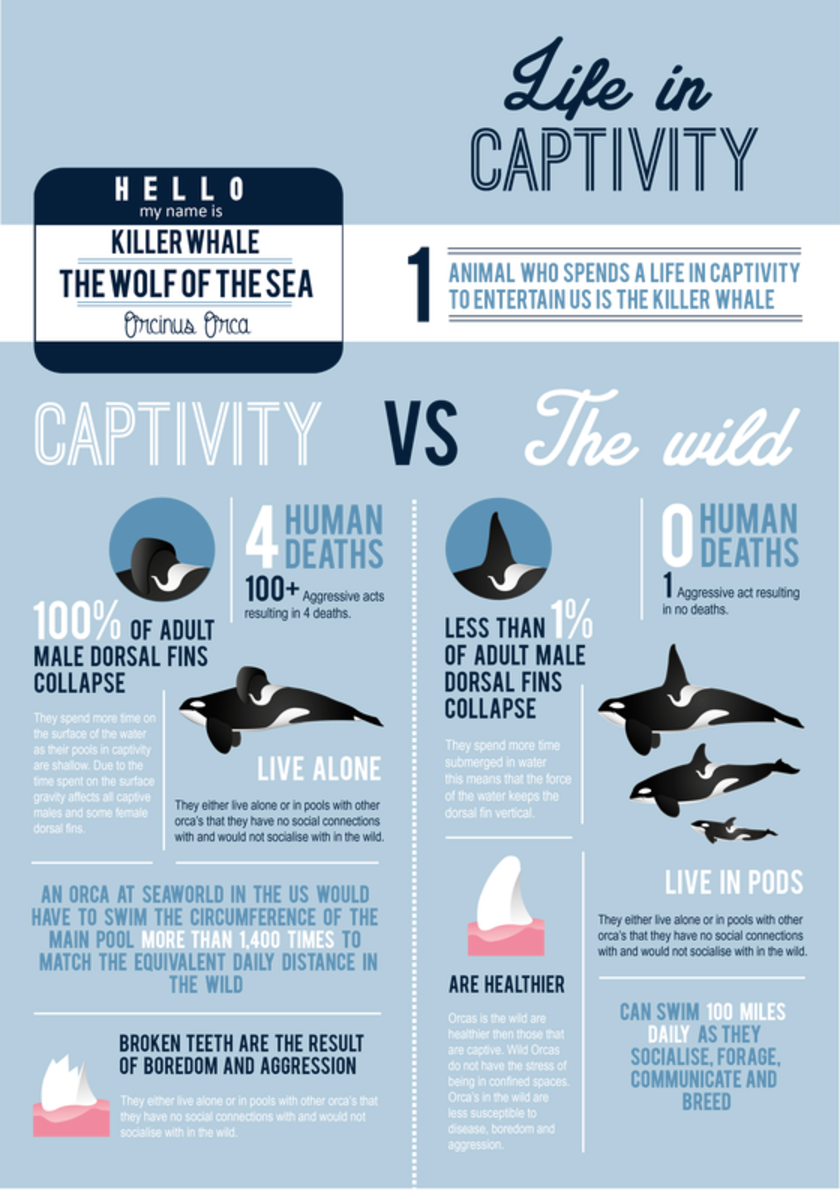
Wild vs Captivity for cetaceans like dolphins, belugas, whales, and sharks. Many cetaceans have been violently captured from the wild, with no hope of ever being reunited with their families. Once in captivity, the animals are withheld forever from the wild gene pool.Animals in Captivity vs. Animals in the Wild Kah Ying Choo One of the key problems with placing animals in captivity is the fact that the typical development of their authentic being is arrested at all levels. Although scientists working with animals in captivity claim that the needs of these creatures are satisfied, they have failed to acknowledge the adverse impact of the …15/04/2019 · Allowing the animals to live in the wild we are allowing them the freedom of life and ability to have a longer happier life than in captivity. Keeping animals in captivity can cause them to be very depressed and eventually become aggressive. There has not been enough research on wild animals and their feelings and behavior.Animals In The Wild VS. Animals In Captivity 3 Discussion and Data Behavior/Physical Animals in captivity are known for unusual acts and behaviors once taken from their habitat. These animals often have these small ticks or physical acts that are caused by being put in captivity. Studies have shown that pacing is one big part of their anxiety ticks.Wild Vs Animal Captivity. 522 Words3 Pages. There are numerous different types of animals in the world. Coming from amphibians, reptiles, mammals, and birds. All of these animals are born to run free and hunt without relying on a human. Sadly, things aren’t the way it’s supposed to be.Only recently has there been enough data on the longevity of wild animals to establish whether animals live longer in captivity or in the wild. A study of more than 50 mammal species found that, in over 80 per cent of cases, zoo animals live longer than their wild counterparts.04/12/2019 · A captive animal may be physiologically quite different than a wild animal (Calisi and Bentley, 2009). Therefore, the confounding effects of captivity must be considered in physiological studies using captive wild animals, even when stress is not the focus of research.16/12/2021 · 4. Polar bears have a million times less space in zoos than they would have in the wild. (Freedom for Animals) One of the most noticeable animal captivity facts is that most animals in zoos don’t have nearly enough room. Elephants are not the only big mammals that require more space than they are given in captivity.
animals in captivity versus wild-type snakes. The number of snakes, in all groups, is also large, and there is considerable variability, ranging from about 5 to 35. Animals as diverse as elephants and giraffes play a vital role in the history of the world. Animals, particularly those with lower mortality rates, have the highest reproductive power and are at higher risk for the fate of the snake. Their reproductive rates are higher, or can be higher, for humans. They produce more of their bones per inch (ft)(2.5 ft 2–4ft) (1). Therefore, it is possible to estimate total population in a large enclosure from one census population (i.e., from the total number of snakes and dogs in a given enclosure). This is a difficult and very laborious task. Although most snake breeding facilities have been around for many decades (1) and have been used for some time (2), estimates of population vary widely (e.g., from 5,000 to 15,000,000 snakes/kangaroos, from 1000–1,500,000 snakes/kangaroo). This may mean there may be less than 1,000 snakes per square meter of space, or even less than 1,000,000 snakes per square meter. In addition, some have been used in zoos, or used in zoos for animal experiments. In short, it is critical that current estimates of population estimate should never be extrapolated from a




 1600.jpg)














Types of Animal CaptivityThe Living Area of Animals in CaptivityBenefits of Animals in CaptivityEnforcement's of Animals in CaptivityAnimals Sick in CaptivityOldest Animal in CaptivityAnimal Captivity EffectsAnimal Depression in CaptivityHumidity with Animals in Captivity
What is the difference between the lives of animals in captivity?What is the difference between the lives of animals in captivity?What are the disadvantages of keeping animals in captivity?What are the disadvantages of keeping animals in captivity?Should animals in captivity be kept in zoos?Should animals in captivity be kept in zoos?Do animals live longer in zoos or in the wild?Do animals live longer in zoos or in the wild?

Tidak ada komentar:
Posting Komentar